
Asia’s Supply‑Chain Bounceback: The Fallout of ‘Liberation Day’ in Asian Equities
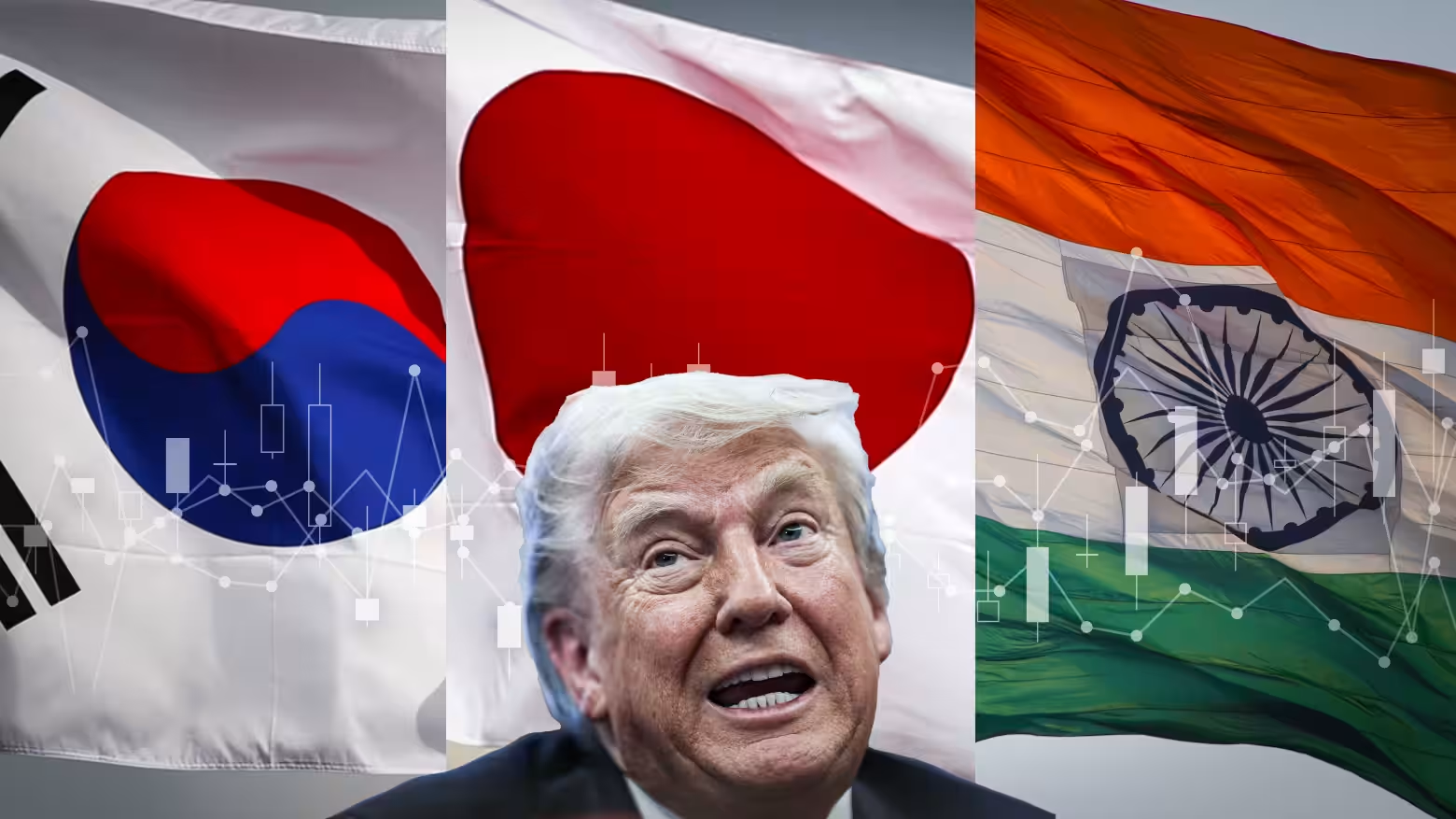
The “Liberation Day” Pivot: April 2, 2025
On April 2, 2025 (dubbed “Liberation Day”) the U.S. imposed sweeping 34% reciprocal tariffs on Chinese imports, prompting Beijing to retaliate with a 34% levy and suspend rare‑earth exports critical to global tech chains. This trade salvo launched a new structural regime of strategic decoupling.
Months later, talks in Geneva and London yielded a framework agreement confirming that rare-earth exports to the U.S. will resume, while the U.S. maintains a 55% effective tariff on Chinese goods and China keeps a 10% tariff on U.S. goods. Despite this framework, many non-tariff barriers and export controls remain in place, especially around AI chips and magnet material.
1. US-China Tech Race: The Great Divergence
NVIDIA vs. Foxconn Technology
NVIDIA (1.430) has zoomed ahead, capitalizing on U.S. AI leadership, tightened export controls, and limited Chinese access to chip design tools.
Foxconn (0.984), despite its crucial role in Taiwan and Apple’s supply chain, shows stagnation amid persistent cross–Strait pressure.
Semiconductor Manufacturing vs. NVIDIA
China’s top foundry (0.991) remains flat while NVIDIA surges, highlighting the widening gap from U.S. export controls limiting access to advanced semiconductor machinery and software.
Xiaomi vs. Apple
Xiaomi outperformed Apple by ~36% (1.286 vs 0.946), leveraging strong demand in emerging markets and avoiding some of Apple’s volatility in mainland China.
2. US-Europe: Brinkmanship Before the Deadline
ASML vs. Intel & Tesla vs. Volkswagen
ASML marginally outpaces Intel (1.09 vs 1.00), and Tesla outperforms Volkswagen (1.036 vs 0.972). These modest divergences suggest markets are anticipating a U.S.–EU political understanding to soften but not eliminate tariffs on autos and steel ahead of the looming July 9 deadline.
Tokyo Electron vs. Micron
Both are strong performers (~1.31 vs 1.35), reflecting the resilience of the U.S.–Japan semiconductor alliance and growing regional tech collaboration.
3. China-EU: Automotive Tensions
BYD vs. Volkswagen
BYD (0.972) edges out Volkswagen (0.911), hinting at China’s expanding EV export ambitions—even as EU regulators push back on subsidies and market access.
BASF vs. CATL
CATL (1.047) significantly outperforms BASF (0.896), epitomizing the shift to Chinese dominance in battery supply chains and energy storage technologies.
4. ASEAN: The Big Winner
Delta Electronics (ASEAN) vs. Tesla
Delta Electronics’ massive rise (1.64 vs 1.04) stands out. Its 64% return cements ASEAN’s emergence as a key trade beneficiary of U.S.–China turmoil.
ASEAN: Asia’s Quiet Winner
ASEAN remains China’s largest trading partner, with trade in Q1 2025 reaching ¥1.71 trillion (~$234 billion) - a 7.1% YoY rise and 16.6% of China’s total trade.
The China‑ASEAN FTA 3.0, concluded in May, includes new chapters on the digital and green economy, and supply‑chain integration - a direct accelerator for ASEAN-based firms like Delta, Top Glove, and PTT.
ASEAN’s exports to both China (+15% in 2024) and the U.S. (+12%) soared—revealing regional trade diversification rather than diplomatic alignment.
5. Key Trade Developments FY25
US–China: A London‑Geneva framework confirms rare–earth resumption and exports of AI chip software to China, even as reciprocal tariffs remain high ().
US–EU: Pressure mounts to convert tension into a “political understanding”—with potential easing of auto and steel tariffs after July 9 .
US–Japan / South Korea: U.S. seeks to extend 90‑day tariff pause; firms coordinate semiconductor supply lines more closely.
China‑ASEAN: FTA 3.0 in force; ASEAN attracts manufacturing shifting from China to Southeast Asia.
6. Investment Takeaways for Asia-Focused Readers
Elevated U.S. AI dominance continues to benefit NVIDIA-like stocks.
ASEAN equities—particularly those with electronics or battery exposure—are likely to stay strong amid supply chain realignment.
Chinese tech export firms see pressure from export controls, but consumer champions like Xiaomi hold promise in regional markets.
EU multinationals remain exposed to deal uncertainty, making them less compelling in the short run.
Catastrophic disruption remains possible, but recent frameworks suggest strategic escalation, not collapse.
These patterns suggest that while the immediate trade war tensions may stabilize through framework agreements, the underlying strategic decoupling and supply chain realignment will continue to drive market performance for the foreseeable future.




 View certificate