
The So-What
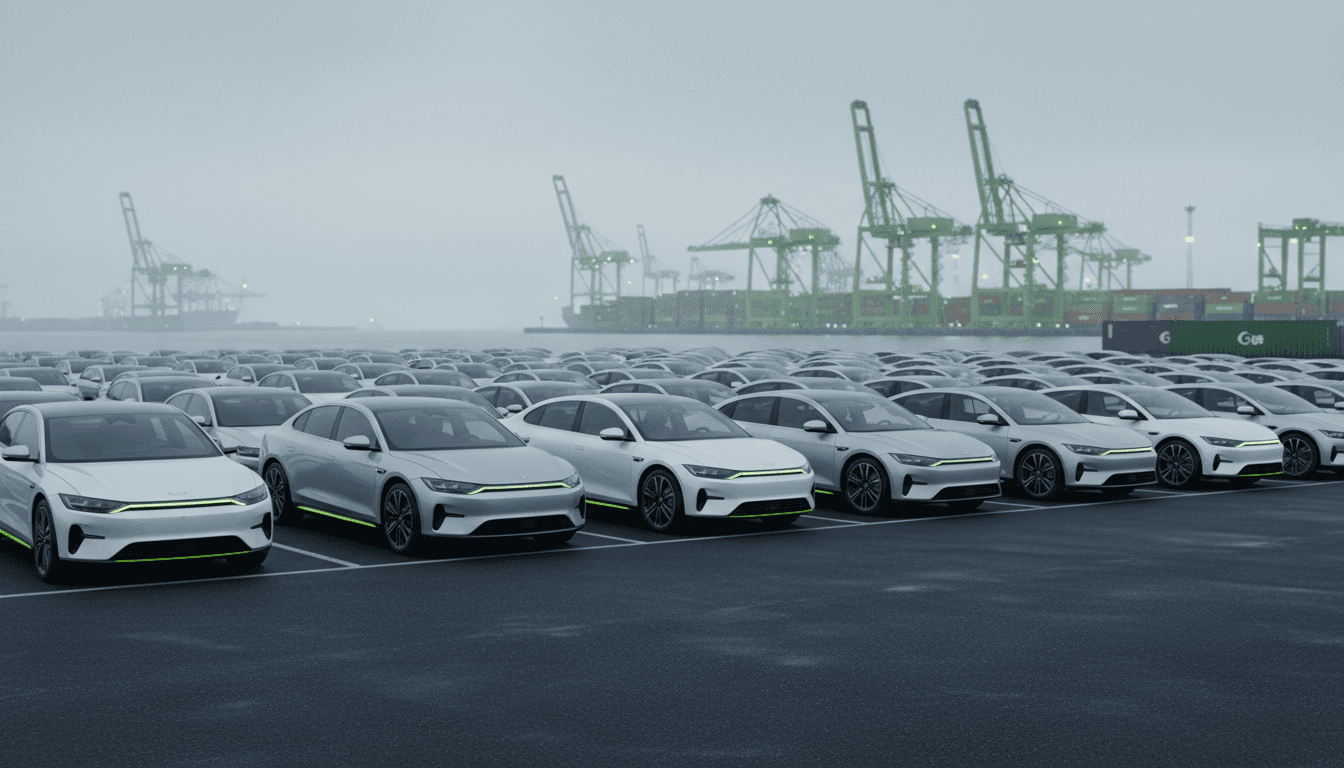
China's carmakers just proved that flooding foreign markets is no longer optional, and the numbers show the flood is arriving faster than buyers can absorb it. In July, Chinese automakers exported a record 540,000 electric and plug-in hybrid vehicles, one for every two cars sold at home, versus one for every five a year earlier 1. Investors reading that as a demand story are missing the mechanism: it is a capacity story, and the gap between what is shipped and what is sold is starting to show up as unsold metal sitting in ports and dealer lots from Rotterdam to Rio.
A Seventh Straight Month of Domestic Declines
The export surge is not opportunistic, it is defensive. China's EV deliveries fell 3.9% year-over-year in July, the seventh consecutive monthly decline, as fading subsidies and a slowing economy sapped demand even from the premium tier 2. Xpeng delivered 38,027 vehicles in July, down 5.2% from June; Nio delivered 35,934, down 11.5%; and Li Auto logged its fourth straight month of falling deliveries at 30,468 2. Sales inside China are down 12% over the first seven months of 2026, and the International Energy Agency now expects the domestic market to end the year flat for the first time this decade 1. As Bill Russo, founder of the Shanghai-based advisory firm Automobility, told Rest of World, the industry has moved from export opportunity to export necessity 1.
The Math That Should Worry Investors
Here is the number that matters more than the export record: in the first half of 2026, China's EV exports rose 120% year-over-year, but sales of those cars in overseas markets grew only 75% 1 4. That roughly 45-point gap is a proxy for inventory quietly building up abroad rather than moving through dealer networks, cars that count as revenue the moment they clear customs whether or not a retail buyer has taken delivery. It echoes what is already visible at home: passenger-vehicle inventory across China stood at 3.43 million units at the end of June, equivalent to about 62 days of sales, with EV-focused manufacturers alone holding roughly 790,000 units on lots 5. Exporting inventory does not eliminate that problem for a balance sheet, it just relocates it, and it adds currency, shipping, and tariff variables that a domestic unsold car does not carry.
Manufacturing the Escape Route
The industry is not simply shipping finished cars faster, it is restructuring how it exports to dodge the tariff walls a pure volume strategy would hit. The European Union's duties and Washington's roughly 100% tariff on Chinese EVs have closed the two largest addressable markets, so growth is concentrated in Brazil, Thailand, the Gulf, and other markets without those barriers, increasingly through local assembly rather than direct shipment 1. Southeast Asian tariff exemptions that used to soften the landing lapsed in December 2025, pushing automakers toward the same knockdown-kit model BYD already runs in Brazil and SAIC-GM-Wuling runs in Indonesia: shipping components rather than finished vehicles to qualify as local production. AlixPartners now projects Chinese-brand vehicle exports will approach 10 million units in 2026, up 41% from 7.1 million in 2025, which would make China the first country to clear that threshold in a single year 3. NEV exports specifically rose 148% year-over-year in July alone 4.
CATL and BYD Still Win Even If Dealers Don't
Upstream, the picture is less ambiguous. China's EV battery installations hit 74.6 gigawatt-hours in July, with CATL holding 42.33% of that market and BYD's in-house battery unit at 19.23% 6, a reminder that even a price war that crushes automaker margins keeps cell volumes climbing, since every exported car still needs a battery regardless of where or whether it ultimately sells. That decoupling is worth tracking for investors positioned in the battery supply chain versus the assemblers absorbing the discounting.
The One Bright Spot: Selling Fewer, Better Cars
Not every overseas move looks like liquidation. BYD's Racco, an electric kei-class minicar built in Changzhou and launched in Japan on July 28, took more than 1,000 orders in its first two weeks, notable because Japan's kei-car segment had never been cracked by a foreign automaker. BYD is targeting 10,000 reservations by year-end with a model priced from roughly 2.14 million yen, about $13,470 7. It is a small volume next to the export totals, but it is evidence BYD can win a protected, high-standards market on product terms rather than by discounting into a glut.
What to Watch
The signal to track through year-end is not the export headline, it is the gap between shipped and sold. If overseas retail sales close the distance with export volumes, the strategy is working. If the gap widens further, expect margin pressure to follow Chinese EV makers overseas the way it has already hollowed out profitability at home, where only a handful of roughly 30 domestic EV brands are consistently profitable, and expect importing governments to respond with the same tariff and localization tools the EU and US have already deployed.
- [1]China's EV export surge reshapes global auto markets — Rest of World, 2026-08-20
- [2]Price war fears grip China's EV market after woeful July sales figures — South China Morning Post, 2026-08-01
- [3]China Auto Exports Expected to Near 10 Million in 2026 Amid Overseas Push — Caixin Global, 2026-07-02
- [4]China NEV Exports Surge 148% in July, Offset Weak Domestic Demand — ChinaEVHome, 2026-08-11
- [5]China NEV retail sales fall for sixth month as exports surge — CnEVPost, 2026-07-08
- [6]China EV Battery Installations Hit 74.6 GWh in July: CATL Holds 42.33%, BYD 19.23% — ChinaEVHome, 2026-08-18
- [7]BYD Racco received over 1,000 orders two weeks after the launch — CarNewsChina, 2026-08-10



 View certificate