
Two Signals, Eleven Days Apart
China's property policy sent investors two contradictory signals in the same month. On August 20, Shanghai rolled out an eight-point package cutting the minimum down payment on second homes outside the outer ring road to 15% from 20%, unlocking housing provident fund withdrawals for completed new homes, and offering trade-in subsidies of up to 80,000 yuan through March 2027 6. It followed Beijing, which on August 7 relaxed home-purchase restrictions for non-local buyers and doubled its provident fund loan ceiling to 3.4 million yuan, timed to catch the 'Golden September, Silver October' peak sales season 7. Then, on August 28-29, three national regulators did something that cuts the other way: they moved to dismantle the presale financing model roughly four-fifths of new Chinese homes are still sold under 3. Property developer shares fell sharply once the market absorbed what that means for cash flow 5. For investors, the read is not simple stimulus. It is Beijing simultaneously propping up demand in its strongest cities while forcing a costly restructuring of how developers get paid.
Killing the Presale Playbook
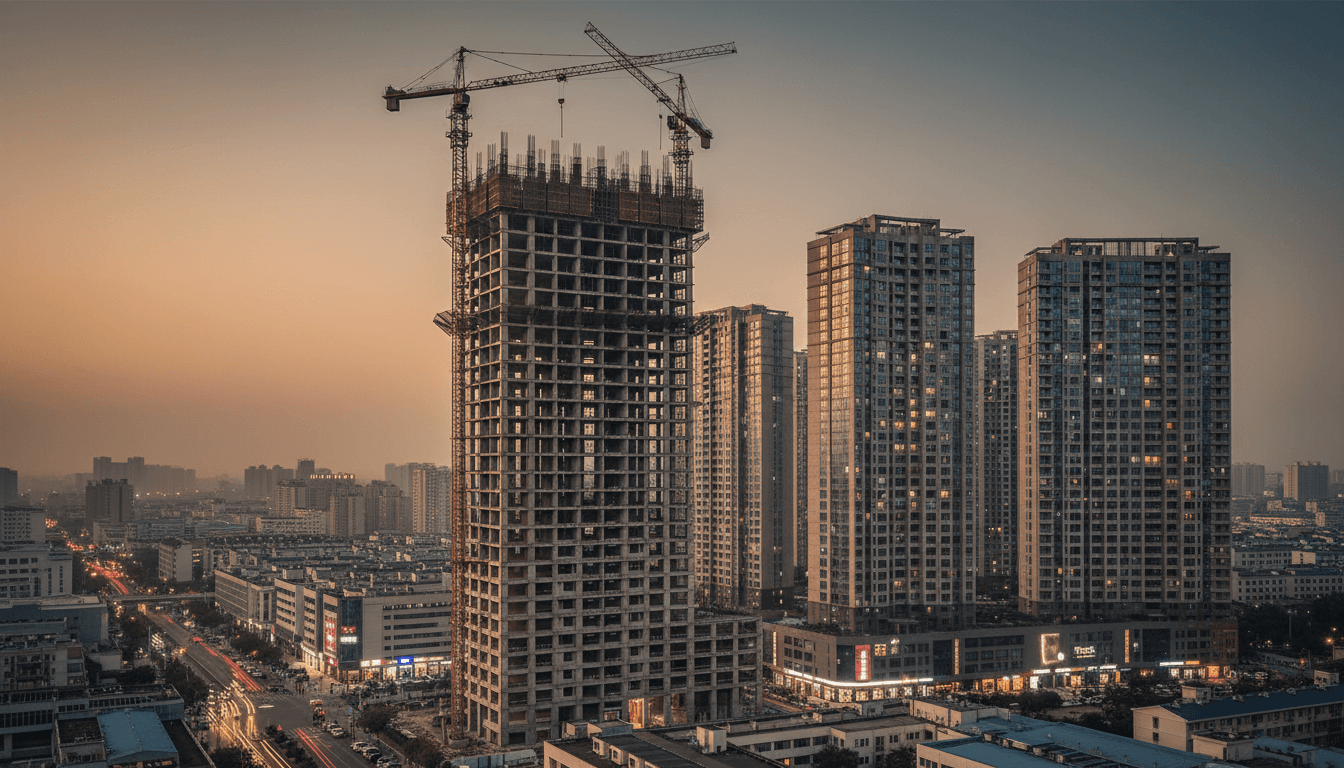
The new rules, issued jointly by the Ministry of Housing and Urban-Rural Development, the Ministry of Natural Resources and the National Financial Regulatory Administration, require developers to top out a building's main structure before they can begin presales at all 1 2. More consequentially, funds from presale down payments and mortgages must now stay in escrow and cannot reach developers until a project is fully completed, reversing a practice that let builders draw funds once construction merely topped out 2. Personal mortgages follow the same logic: loans for presale homes are issued only after project completion is registered, while loans for already-completed homes can be issued once a sale is registered 3. Regulators softened the blow with one concession, extending the maximum mortgage term to 40 years from 30 2 3, and exempted projects that already held planning permits before August 28, though those still fall under the new escrow rules 3. Projects launched after that date effectively lose the early-cash advantage that has defined Chinese homebuilding for two decades.
Why Beijing Is Squeezing Both Ends at Once
The timing is not a coincidence. Roughly 85% of new homes in China are still sold before completion, up from about half in 2005, and that dependency is precisely what produced the stalled-project crisis that has haunted buyer confidence since the 2021 downturn 3 4. Regulators are betting that removing developers' access to buyers' cash before delivery will rebuild trust in a way rate cuts alone cannot 4. But confidence-building only works if buyers keep showing up, which is where the demand-side easing comes in. July data help explain the urgency: new home prices across 70 cities fell 3.2% year-on-year, a 37th straight month of decline even as the pace was the slowest since February, while property investment for the first seven months of 2026 dropped 19.2% and land sales revenue fell 30.8% to 1.17 trillion yuan 8. Shanghai was the lone standout, with prices still rising 3.0% year-on-year 8, which is likely why it, not a struggling tier-two city, got first crack at the newest round of demand easing.
Who Wins, Who Gets Squeezed
The presale overhaul is not evenly distributed pain. Goldman Sachs has framed the reform as supportive for valuation recovery among cash-rich, state-owned developers such as China Resources Land and China Overseas Land & Investment, which can absorb slower cash-cycle timing 9. J.P. Morgan is more cautious, arguing the marginal benefit of further policy easing is fading and the market now needs fundamental improvement, not another round of support 9. The market's initial verdict was blunt: China Resources Land fell 7.7%, China Jinmao dropped 14.7%, Greentown China lost 12.8%, China Overseas Land & Investment fell 6.4% and China Overseas Property declined 3% in the session after the rules landed 5. One analyst cited by SCMP estimated developers' average levered return on investment could fall by roughly 60% under the new financing timeline 4. Smaller, presale-dependent private developers with thin cash buffers are the likeliest to exit or be absorbed, which regulators appear to view as a feature of the reform, not a side effect 4.
The Investor Read
Treat this as a bifurcation trade, not a sector call. The near-term overhang is real: developers lose early access to buyer cash exactly as land sales and investment keep contracting, and equity markets will keep discounting weaker balance sheets until Golden September sales data show whether Shanghai- and Beijing-style easing is translating into actual transactions rather than just eligibility. The medium-term thesis favors large, state-backed developers and their bondholders, who gain relative pricing power as the presale-dependent competitive fringe shrinks, and it favors completed-inventory and rental-conversion plays over off-plan land banks. Watch for two things next: whether other tier-one and strong tier-two cities follow Shanghai's down-payment cut, and whether the August 28 planning-permit cutoff triggers a rush of new project launches timed to dodge the escrow rules before it fully bites.
- [1]China moves to improve commercial housing sales system — Xinhua, 2026-08-29
- [2]China Overhauls Real Estate Credit Rules in Shift Away From Presale Model — Caixin Global, 2026-08-28
- [3]China Raises Threshold for New-Home Presales Under New National Standard — Caixin Global, 2026-08-29
- [4]What do China's new housing presale rules mean for real estate developers? — South China Morning Post, 2026-08-31
- [5]China's property stocks tumble as new rules upend presale funding playbook — The Star (Reuters), 2026-08-31
- [6]China's Shanghai eases housing policies to spur demand — Reuters via AOL, 2026-08-20
- [7]Beijing Follows Shanghai in Easing Homebuying Restrictions — Bloomberg, 2026-08-07
- [8]China reports narrowed home price declines in July, another sign of market stabilization — China.org.cn, 2026-08-18
- [9]Beijing Eases Property Curbs for Third Time; Goldman Sachs, J.P. Morgan Bullish on State-Owned Developers Ahead of Peak Season — BigGo Finance, 2026-08-10



 View certificate