
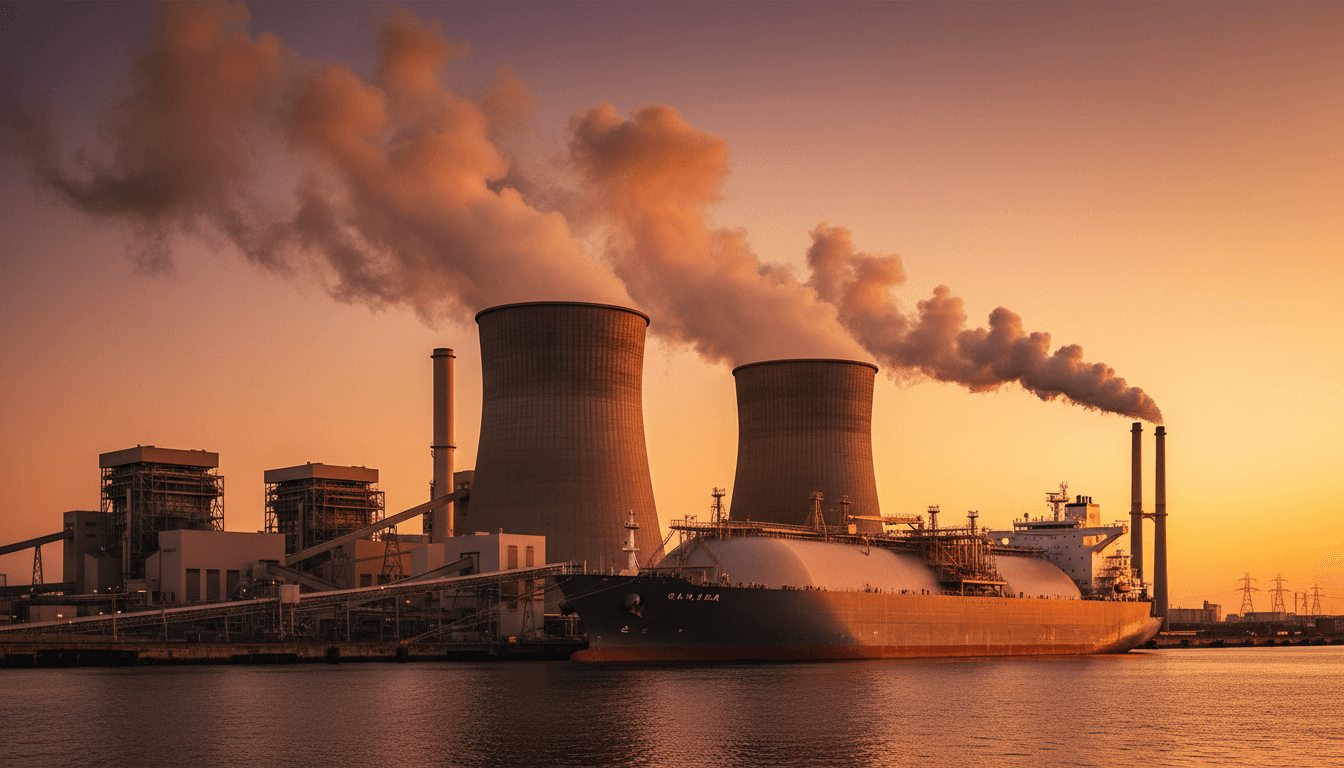
The Missiles That Rewired Asia's Fuel Mix
Asia's energy mix just took its sharpest wartime detour in a generation, and it started at a gas complex most investors had never had to think about. Beginning in March 2026, Iranian missile and drone strikes hit Qatar's Ras Laffan Industrial City, the world's largest LNG export hub 1. Two of Qatar's 14 liquefaction trains, S4 and S6, run in partnership with ExxonMobil, sustained severe damage alongside one of the site's two gas-to-liquids units 1. Together the disabled trains account for 12.8 million tonnes per annum, roughly 17% of Qatar's export capacity, and close to a fifth of global LNG supply by some estimates 1. Wood Mackenzie now says the site may not fully resume output before the end of August, with full restoration potentially taking up to five years 2.
That matters disproportionately for Asia because the region absorbs roughly 90% of Qatar's LNG exports 1. China, South Korea, India and Pakistan are the buyers most exposed, and the region's response has been immediate and structural rather than temporary: a wholesale pivot back to coal.
Coal's Comeback, By the Numbers
Rystad Energy's June 2026 assessment puts the scale of the shift at 70 million tonnes of incremental Asian coal demand this year under its tight-gas scenario, with some forecasts running as high as 100-150 million tonnes depending on how long the Middle East disruption drags on 3 4. Crucially, Rystad notes this is not new coal capacity coming online — it is existing fleets running harder, which is the kind of demand that shows up in spot prices almost immediately 4. Newcastle benchmark thermal coal is now expected to average around 125 dollars a tonne in 2026, and international seaborne coal prices are already up roughly 13% since the conflict began, a far gentler move than the more than 60% spike in north Asian LNG spot prices over the same window 5 6.
Japan is leading the shift. JERA, the country's largest utility, has committed to keeping coal plants at high utilization, and national data show coal-fired generation up 11% even as gas output fell 13% 4 5. South Korea and Taiwan are seeing similar coal-for-gas substitution, and in Southeast Asia the pattern repeats: the Philippines is ramping coal and cutting LNG-fired output, Thailand is leaning on its largest coal plant to preserve gas cargoes for peak demand, and Vietnam's state utility EVN is renegotiating coal supply contracts 6.
Who Wins: Coal Miners Reload
The equity read-through has already shown up on the ASX. Thermal coal is up more than 20% in 2026 even as broader equity markets have wobbled, and Australia's listed producers have been the direct beneficiaries: Whitehaven Coal is near a three-year high, New Hope Corporation is trading at levels not seen since 2023, and Yancoal Australia has rallied alongside them 7. The move has been reinforced by supply-side tightness elsewhere — a fatal mine accident in China's Shanxi province and a new Indonesian rule funneling coal exports through a state-owned entity have both added scarcity on top of the Asia demand shock 7. For Indonesian producers such as Adaro Energy and Bumi Resources, the setup mirrors prior coal cycles: a regional utility scramble for tonnes tends to lift realized export prices faster than it lifts costs, particularly for miners with existing contracted volume into Japan, Korea and the Philippines.
Who Loses: The LNG-Dependent Squeeze
The pain is concentrated in economies with the least ability to absorb higher energy import bills. Bangladesh has cut government fuel allocations by 30% and shifted parts of the school calendar online to save power, Pakistan has compressed its work week, and India has begun rationing gas by sector — protecting residential and CNG transport supply while cutting refineries to roughly 65% of normal allocation and fertilizer plants to about 70% 1 2. One analyst tracked in the reporting cut its 2026 Asian LNG import forecast to around 5 million tonnes from a prior 12.4 million tonnes, assuming just a two-month Middle East disruption — a assumption that already looks conservative given the Ras Laffan timeline 6.
The Investment Read
The trade here is less about picking a single winner than recognizing that Asia's energy security calculus has reset for the remainder of this decade, not just this year. Coal miners with Asia-facing contracted volume are capturing a genuine, structurally supported repricing rather than a speculative spike, and that repricing looks durable as long as Ras Laffan's restoration timeline keeps slipping. On the other side, LNG-import-dependent utilities and industrial users across South and Southeast Asia face margin compression or rationing that is now a multi-year planning assumption rather than an emergency measure, which should factor into how investors underwrite power, fertilizer and refining names tied to gas-constrained markets. The clearest signal to watch is Ras Laffan's own recovery news: every slip in that timeline pushes coal demand, coal prices and Asian utility earnings further apart.
- [1]Ras Laffan attacks could reshape global LNG supply as outage timeline extends — World Oil, 2026-03-20
- [2]Qatar's Ras Laffan LNG site may not fully resume before August — The Business Standard, 2026-06-15
- [3]Asia's Coal Demand to Jump 70 Million Tonnes in 2026 as LNG Shortfall Bites — OilPrice.com, 2026-06-11
- [4]Asia's coal demand to rise by 100 million tonnes in wake of Middle East conflict — Rystad Energy, 2026-06-11
- [5]Japan's coal power generation climbs as war makes LNG more expensive — The Japan Times, 2026-05-13
- [6]Asian utilities boosting coal-fired power generation to offset skyrocketing LNG prices — Middle East Online, 2026-07-20
- [7]Three supply shocks in three weeks: Why coal stocks are running hot — Market Index, 2026-08-10



 View certificate