
A company with no website
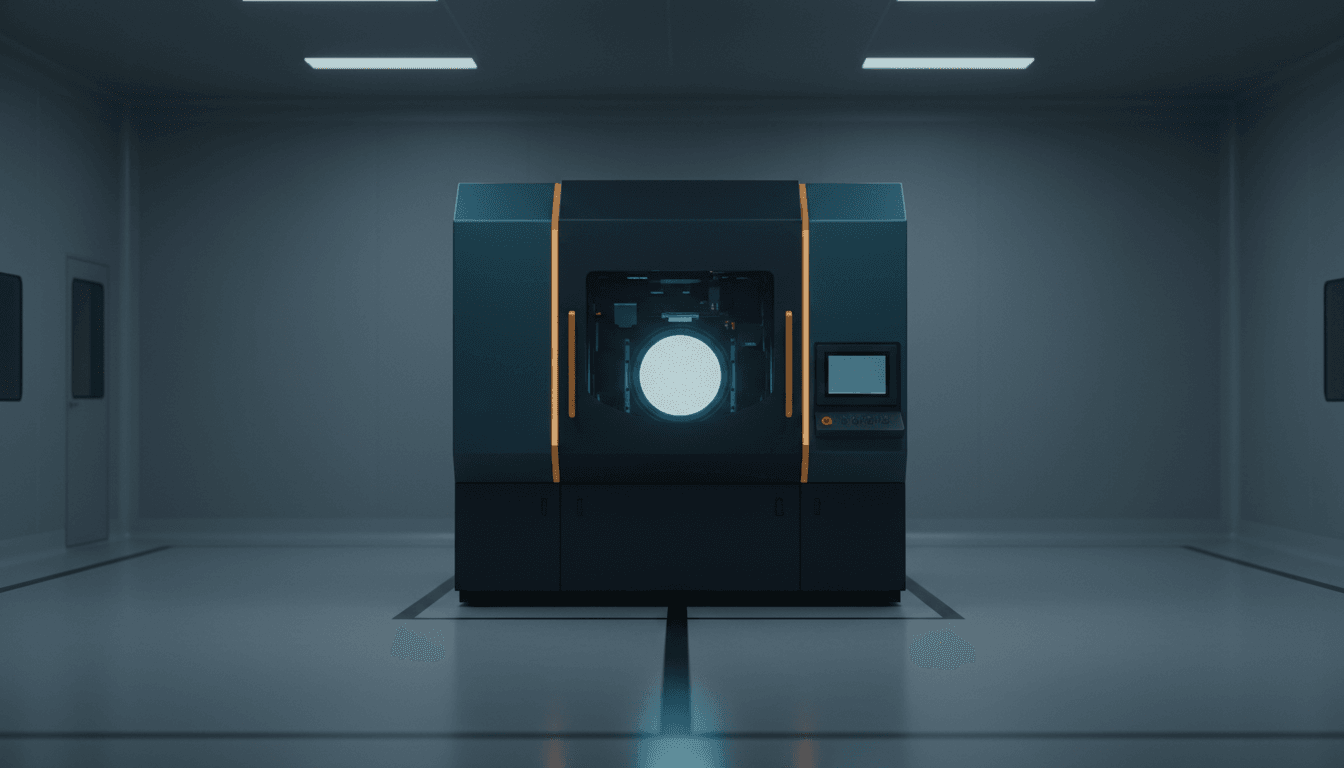
On July 28, Reuters confirmed something Chinese state media had never announced: a Shanghai firm called Aishengna Electronic Technology Group had begun mass-producing immersion deep ultraviolet lithography machines, the workhorse tools used to print circuits onto silicon 1. The company has no public website, has never issued a press release, and until that report most chip-industry analysts had never heard its name. Within 48 hours, it had become the most consequential Chinese company nobody could place on an org chart.
The production targets are modest on paper: roughly five immersion DUV systems in 2026, scaling to about twenty in 2027, headed first to SMIC, Hua Hong Semiconductor and memory maker ChangXin Memory Technologies 2. But the market did not react to the volume. It reacted to the fact that volume now exists at all, on a timeline years ahead of most industry forecasts for a domestically built, ASML-independent scanner reaching production fabs.
Why Black Tuesday happened
The reaction was immediate and disproportionate to the actual unit count. On what Korean outlets dubbed a black Tuesday, the KOSPI fell 10.8 percent, Taiwan's chip-heavy benchmark dropped roughly 5 percent, and Japan's market slid about 4 percent 4. In the US, the Philadelphia semiconductor index fell 5 percent and a DRAM-tracking ETF dropped 9 percent as traders concluded that China's equipment localization runway had just gotten shorter than priced in 4.
ASML absorbed the sharpest single-name hit. The Dutch lithography monopolist lost 18 percent of its market value in July, a decline that started with unrelated worries about Anthropic's custom AI chip work and then compounded on the Aishengna news 7. The timing embarrassed the bears: ASML had just raised full-year 2026 revenue guidance to a range of 43 billion to 45 billion euros, up from 36 billion to 40 billion, and posted second-quarter earnings ahead of expectations, with chief executive Christophe Fouquet citing surging orders and expanded capacity 7. Investors sold anyway, pricing in a future in which China's largest fabs need fewer export licenses and fewer ASML tools to keep running.
Who is actually behind it
Aishengna was incorporated in August 2023 with 7 billion yuan, roughly 1 billion dollars, in registered capital, backed by just two state shareholders: Shanghai Electric Holding and a subsidiary of Shanghai International Trust 5. It is effectively a consolidation vehicle. The firm absorbed engineering teams from Shanghai Micro Electronics Equipment, the state lithography developer better known as SMEE, which last year spun its immersion DUV technology and staff out of its own EUV program, and from Yuliangsheng, a Shanghai-based startup founded in 2022 with roughly 149 million dollars in capital that had already delivered prototype scanners to fabs for testing 2 5. In effect, Beijing spent two years quietly merging its scattered DUV talent into a single, better-capitalized entity before letting it go public with hardware rather than announcements.
That structure matters for how investors should read the story. This is not a scrappy startup outrunning incumbents; it is a state-directed rollup designed to convert years of fragmented, underfunded lithography efforts into one supplier with a production mandate and a straight line to China's three largest chipmakers.
Filling in behind ASML, at a cost
Even bulls concede the gap to ASML remains wide. Aishengna's tools are immersion DUV, roughly comparable to systems ASML shipped over a decade ago, and analysts estimate China's domestic lithography stack still trails ASML's current low-NA and high-NA EUV lineup by multiple generations 6. Critical subsystems, including precision optics and certain metrology components, are still reportedly sourced from Japanese suppliers, meaning Tokyo's export-control decisions still gate how fast Aishengna can actually scale to its 2027 target 6. The 20-machine goal for next year assumes a domestic component base that, by most industry accounts, does not yet fully exist.
Beijing is hedging its own bet. Alongside the DUV push, Chinese developers are advancing an early-stage EUV prototype, reportedly targeting first working chips only around 2028 to 2030, and separately pursuing glass-substrate packaging as an alternative path to performance gains that does not require matching ASML's scanners at all 3 5. Huawei has signaled plans to mass-produce glass substrates as soon as 2027. None of this closes the lithography gap soon. It does show a state apparatus attacking the chokepoint from three directions simultaneously rather than betting everything on one.
What it means for investors
The immediate read-through is narrower than the selloff implied. Five to twenty machines a year does not replace ASML's installed base or its EUV monopoly, and Aishengna's near-term customers are mature and specialty nodes, not leading-edge logic. But the medium-term signal is real: China's equipment localization curve just proved steeper than consensus assumed, which should worry any Asian supply-chain name whose multi-year revenue model depends on China staying dependent on foreign lithography. Japanese optics and materials suppliers gain a fragile, license-gated bridge role in the meantime. Korean memory makers gain a second domestic-adjacent tool vendor to negotiate against. And ASML, still the only company selling EUV to anyone, keeps its monopoly premium intact for now, but its China revenue assumptions deserve a harder look every time Shanghai ships another unmarked machine.
- [1]Exclusive-China starts production of home-grown immersion DUV chipmaking tools, source says — Reuters via Yahoo Finance, 2026-07-28
- [2]China Reportedly Mass-Produces Immersion DUV Tools; SMIC, Hua Hong, CXMT Deliveries Expected This Year — TrendForce, 2026-07-28
- [3]China begins mass production of homegrown immersion chipmaking machines in major breakthrough, report claims — Tom's Hardware, 2026-07-28
- [4]Who Is China's DUV Firm Aicheng That Triggered Chip 'Black Tuesday'? — Seoul Economic Daily, 2026-07-29
- [5]Shanghai Aishengna: The Secretive Company Behind China's Latest DUV Lithography Push Thoroughly Unmasked, As Beijing Hedges With Glass Substrates And An EUV Prototype — Wccftech, 2026-07-30
- [6]Chinese chipmaking tool roadmaps examined — Beijing's nascent lithography tools target DUV production at five machines a year, and an EUV prototype with no chips — Tom's Hardware, 2026-07-30
- [7]Why ASML Stock Lost 18% in July — The Motley Fool, 2026-08-04



 View certificate