
The order that broke a habit
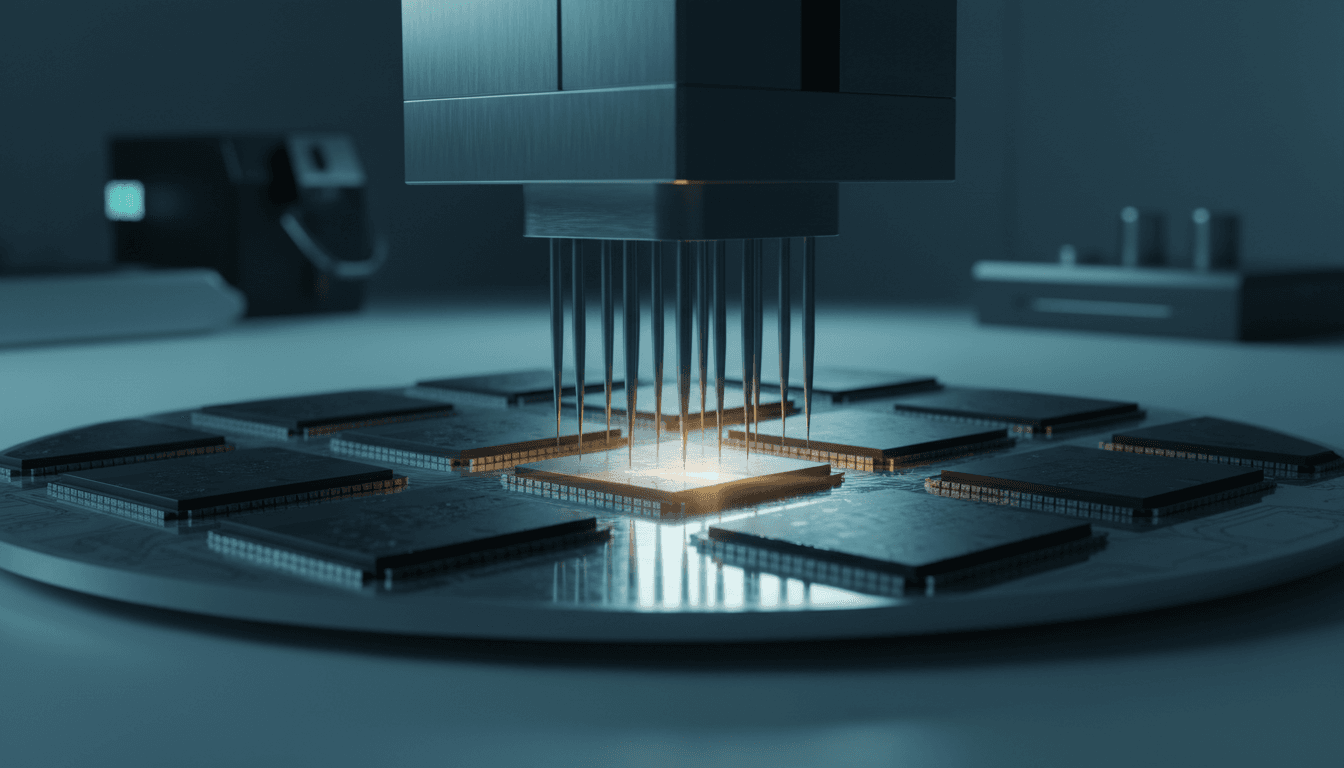
For most of the AI boom, testing an HBM chip before it shipped to Nvidia meant one name: Advantest. The Japanese company's testers have been the default at SK Hynix, Samsung and every other memory maker racing to qualify high-bandwidth memory for the next generation of AI accelerators. That default just cracked. Two small South Korean equipment makers, Digital Frontier and UniTest, have secured four wafer-tester orders from SK Hynix worth a combined KRW247.84 billion, or roughly $172 million, tied directly to HBM4 production ramp-up 1. UniTest's share alone was KRW22.4 billion 2. Neither company has been a meaningful name in wafer test before this year.
The dollar figure is small next to Advantest's balance sheet. The signal is not. This is the first time a Korean memory maker has visibly diverted wafer-test spending for its most strategic product away from Advantest and toward domestic suppliers, and it arrives exactly as HBM4 becomes the tightest bottleneck in the entire AI hardware stack.
Why Advantest owned this in the first place
Advantest's grip on chip testing was not an accident of habit; it was earned through capacity nobody else could match. Average lead times on its automated test equipment have run past six months as GPU and HBM demand outstripped supply, and the company told customers in early 2026 that orders remained stable even at those lead times because nobody else could absorb the overflow 3. The payoff shows up in the numbers: Advantest's fiscal year through March 2026 brought revenue of roughly ¥1.13 trillion, up 44.7 percent, with operating margin expanding from 29.3 percent to 44.2 percent as SoC test systems grew to 68 percent of total sales from 56 percent a year earlier 7. That is close to the profile of a company with pricing power over an industry that cannot say no.
Which is exactly why SK Hynix's move matters. A customer does not walk away from a supplier with those margins and those lead times unless it has run out of patience, or unless it has a second source it actually trusts.
The diversification logic behind HBM4
SK Hynix has been building that second source deliberately, not opportunistically. In June, the company placed a KRW44.2 billion order with Hanmi Semiconductor for thermo-compression bonders tied to the same HBM4 ramp, a move TrendForce framed explicitly as accelerating production readiness ahead of the next generation of AI memory 8. The wafer-tester awards to Digital Frontier and UniTest extend that same pattern one stage earlier in the process: rather than concentrate every critical tool with a single non-Korean vendor, SK Hynix is qualifying domestic alternatives across bonding and testing simultaneously, while HBM4 is still ramping rather than after a shortage forces the issue.
That timing is the tell. Test capacity, unlike most semiconductor equipment, sits directly on the critical path between a wafer and a shippable die — a bottleneck there delays revenue, not just output. Building a qualified second source before volume peaks, rather than during a crunch, is a hedge against exactly the kind of single-vendor lock-in that left much of the industry exposed to Advantest's lead times in the first place.
Taiwan is riding the same wave, without the standoff
The test-equipment supercycle is not confined to Korea, and not every beneficiary is displacing an incumbent. Taiwan's Chroma ATE posted record consolidated revenue of NT$13.5 billion in the second quarter of 2026, up 40 percent from the prior quarter and 110 percent year over year, with its Test Instruments and ATS division making up 56 percent of parent-company sales on the back of AI server power and semiconductor testing demand 4 5. Chroma's semiconductor-testing revenue alone roughly doubled year over year, driven by system-level testers rather than a fight over wafer-test share. Its operating margin hit 39 percent in the quarter, with return on equity nearly doubling to 54 percent 5.
The contrast is instructive: Chroma is capturing AI-driven demand growth without displacing anyone, while SK Hynix and its new Korean suppliers are actively redrawing who gets paid for the same underlying demand. Both are symptoms of the identical shortage.
The macro backdrop: a shortage too big for one supplier
SEMI's July 2026 forecast put global semiconductor test-equipment sales up 31 percent to $15.3 billion in 2026, on top of a 55.3 percent surge in 2025, part of a broader equipment market SEMI now expects to reach a record $229 billion by 2028 6. That growth rate is the real explanation for why Digital Frontier and UniTest could win orders at all: even a supplier commanding the lion's share of a market growing that fast cannot fully absorb the incremental demand, leaving room for qualified alternatives to take a bite without needing to underprice the incumbent.
What it means for investors
Advantest's position is not under near-term threat. A $172 million order redirection is immaterial against Â¥1.13 trillion in annual revenue, and its lead times and margins suggest demand still exceeds what any competitor, Korean or otherwise, can absorb. But the qualification event itself is the risk that matters over a longer horizon: Samsung and other memory makers now have a template — proven domestic testers, real production volume, a paper trail of successful HBM4 orders — that lowers the cost of diversifying away from a single vendor the next time lead times stretch or pricing tightens. For investors in Advantest and Teradyne, the number to watch is not this quarter's margin but how many additional domestic suppliers get qualified through 2027 as HBM4 volume scales.
For investors looking at the suppliers themselves, Digital Frontier and UniTest offer a small, early, high-variance way to play Korea's push for supply-chain independence in memory testing, tied tightly to SK Hynix's own HBM4 execution. Chroma ATE offers a steadier proxy on the same AI test-equipment supercycle, diversified across power, semiconductor and system-level testing rather than concentrated in a single customer relationship. Either way, the lesson from this order is the same one Asia's chip supply chain keeps relearning during this cycle: when demand outruns even the best-positioned supplier, customers eventually go looking for a second one, and the first company willing to deliver wins more than the contract.
- [1]South Korean suppliers win HBM4 tester orders from SK Hynix — DigiTimes, 2026-07-30
- [2]UniTest Wins KRW 22.4 Billion HBM4 Equipment Contract With SK Hynix — The Elec, 2026-07-30
- [3]Advantest ATE lead times remain tight as AI and memory markets expand — DigiTimes, 2026-01-16
- [4]AI product cycle lifts Chroma test demand — DigiTimes, 2026-08-13
- [5]Chroma Ate Inc (TPE:2360) (Q2 2026) Earnings Call Highlights: Record Revenue and AI-Driven Growth Fuel Optimism — GuruFocus, 2026-08-14
- [6]Global Semiconductor Equipment Sales Forecast to Reach a Record $229 Billion in 2028, SEMI Reports — SEMI, 2026-07-14
- [7]FY2025 Consolidated Financial Results — Advantest Corporation, 2026-05-14
- [8]SK hynix Reportedly Places 44.2bn Won TC Bonder Order with Hanmi, Accelerating HBM4 Ramp-up — TrendForce, 2026-06-09



 View certificate