
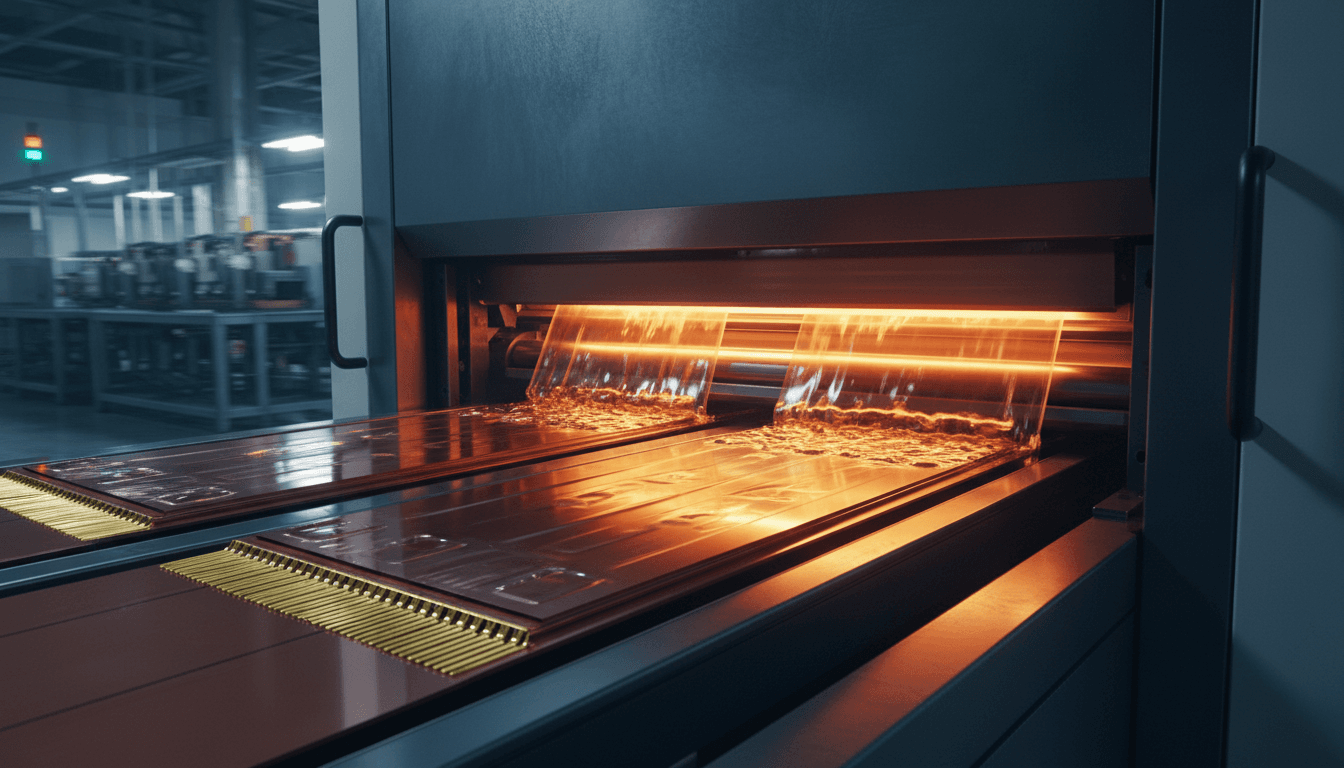
Taiwan's printed-circuit-board and substrate makers are running the most aggressive capital-spending cycle in the industry's history, and by their own numbers, it still isn't enough. Zhen Ding Technology, Unimicron, Nan Ya PCB, Kinsus and ASE Technology have each raised capex guidance in the past five months as AI server orders overwhelm planned capacity. Yet the structural shortage in advanced substrates — the material layer connecting AI chips to circuit boards — is forecast to widen, not close, through 2028 2. For investors, that combination is the story: pricing power is shifting decisively upstream, into a tier of suppliers that used to be treated as commodity subcontractors.
The capex no one budgeted for
Zhen Ding, Taiwan's largest PCB maker, told investors in March that AI-related products were approaching 70percent of revenue and earmarked roughly NT$100 billion in capex over two years to keep pace 7. Five months later, it sharpened that plan further: AI servers, optical modules and IC substrates specifically are now targeted to reach half of total revenue by 2030, backed by cumulative 2025-2028 capital spending of about $4.35 billion, the highest among Taiwanese peers 1. That money is going into a new substrate-like PCB plant at Avary's Shenzhen campus, a Thailand fab in Prachinburi entering small-scale production this half, and an AI-focused campus in Kaohsiung 1.
ASE Technology, the world's largest chip packaging and testing house, moved even faster. It raised its 2026 capex target twice this year, most recently lifting the figure from $8.5 billion to $10.5 billion — a 23.5percent jump that sets a new company record — citing advanced-packaging demand that keeps strengthening into 2027 and beyond 4. Combined with sold-out substrate lines at Unimicron, Nan Ya PCB and Kinsus, the picture is an entire manufacturing tier reinvesting profits into capacity almost as fast as it books them 6.
Substrates, not fabs, are the bottleneck now
Much of the market's attention over the past two years has gone to leading-edge fabrication and lithography tools. But the tighter constraint has moved a step downstream, to the Ajinomoto Build-up Film, or ABF, substrates that carry power and signal between an AI accelerator die and the circuit board. As AI CPUs, GPUs and custom accelerators add more high-bandwidth memory and grow in both size and layer count, substrate demand area is expanding at an estimated 39percent compound annual rate from 2025 through 2028 2. Global substrate makers have already committed roughly $19.1 billion in new capacity, but analysts still expect the supply-demand gap to widen from an estimated 22percent this year toward 29percent by 2028 2 6. One industry analysis this July described advanced packaging, not wafer fabrication, as the binding constraint on the entire AI hardware supply chain heading into 2027 3.
The numbers behind the squeeze
The strain shows up in Taiwan's aggregate output data. PCB production on the island hit a record NT$245.6 billion in the first quarter, and industry trackers expect roughly NT$256.1 billion in the second quarter as AI-server orders keep climbing 5. That is a run-rate few forecasters had priced in even a year ago, and it is happening despite — or because of — persistent shortages of high-end materials such as low-loss copper foil and specialty resins further up the chain.
Brokerages have moved to catch up with the trend rather than lead it. Morgan Stanley and other analysts raised price targets across the board on Unimicron, Nan Ya PCB and Kinsus this year, with Nan Ya PCB's target lifted toward NT$1,275, alongside commentary describing the setup as a multi-year upcycle rather than a short-term squeeze 2 6. That reframing matters: these were historically viewed as thin-margin subcontractors riding whatever cycle the chipmakers set. The capex numbers and sold-out order books argue the relationship has flipped, at least for the companies capable of qualifying for AI-grade specifications.
Who actually captures the upside
Not every supplier benefits equally. Qualifying for AI-server substrate specifications requires capital intensity and yield discipline that smaller regional players in Southeast Asia and China do not yet have, which is why Zhen Ding, Unimicron and Nan Ya PCB — all with over a decade of high-layer-count and ABF experience — are absorbing most of the new orders rather than losing share to lower-cost entrants. ASE's packaging capacity plays a similar role one step further downstream, bundling substrate, test and assembly into a single AI-server supply chain that customers increasingly want to secure in advance rather than shop competitively.
The risk for investors is less about demand than about timing and concentration. If AI accelerator architectures shift toward designs needing less substrate area — a possibility Nvidia and AMD's roadmap changes have already forced suppliers to model — some of this capacity could arrive just as growth in area-per-chip decelerates. Multi-year contracts and record capex commitments cut both ways: they lock in revenue during the shortage, but they also lock these companies into capacity that only pays off if the current substrate-intensity trend in AI chip design holds through the end of the decade.
For now, the order books say it will. Every major supplier in this tier has guided capex higher, not lower, over the past two quarters, and the projected gap between what the industry can build and what AI chipmakers need keeps growing rather than shrinking. That is an unusual position for a subcontracting industry to be in, and it is why Taiwan's substrate and PCB names have become as central to the AI trade as the chipmakers they supply.
- [1]Zhen Ding targets 50% revenue share from AI servers, optical modules, IC substrates by 2030 — DIGITIMES, 2026-08-12
- [2]ABF Substrate Supply-Demand Gap Could Surge to 29% by 2028; Brokers Raise Target Prices for Unimicron, Nan Ya PCB, and Kinsus — BigGo Finance, 2026-07-26
- [3]AI Supply Crisis Moves Upstream: Advanced Packaging Becomes the Binding Constraint — Tech Times, 2026-07-28
- [4]ASE raises capital spending by 23.5% — Taipei Times, 2026-07-31
- [5]AI server demand drives Taiwan PCB output toward NT$256.1B in 2Q26 — DIGITIMES, 2026-06-24
- [6]AI chip rivalry escalates: ABF substrate sells out for Unimicron, Kinsus, Nan Ya PCB — DIGITIMES, 2026-04-20
- [7]Zhen Ding sees AI products near 70% of revenue, sets NT$100 billion capex for 2 years — DIGITIMES, 2026-03-12



 View certificate