
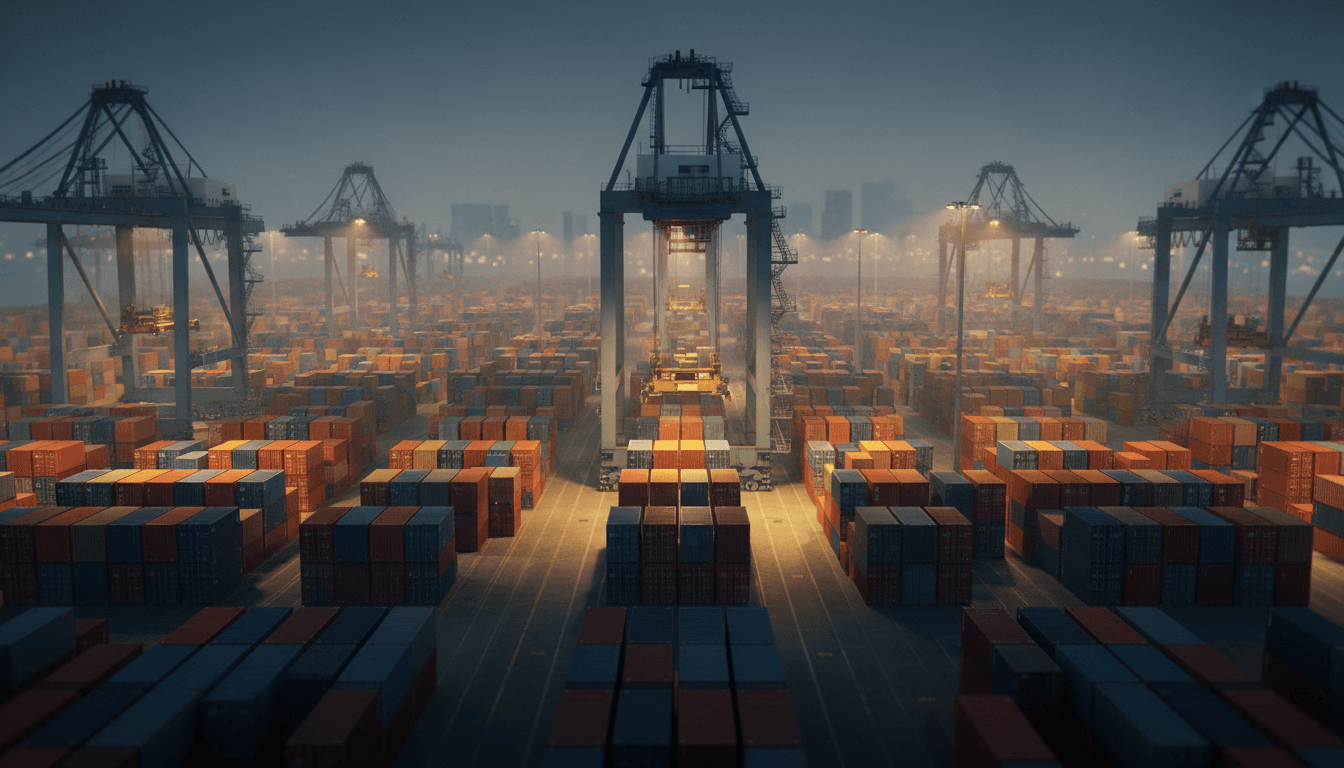
Asia's factories are being rebuilt around software. The region's supply chains are reorganising along two reinforcing lines at once: China is converting its industrial base into a network of AI-run "smart" factories, while a growing share of assembly diversifies into Southeast Asia and India — and, crucially, the new capacity is being designed automation-first rather than labour-first 3. The old logic of chasing the cheapest hands is giving way to one of chasing the most productive machines.
China's smart-factory scale
The scale of China's push is hard to overstate. By mid-2026 the country's official framework counted roughly 35,000 "basic," more than 8,200 "advanced," and over 500 "excellence"-level smart factories, with AI capability increasingly treated as a mandatory benchmark for top-tier plants 1. The results are being measured, not just marketed: ministry data credit participating factories with cutting average product-defect rates by about 47% and shortening development cycles by roughly 38% 1. That productivity leap rests on years of state backing — Beijing channelled north of $20 billion in subsidies into its robotics industry through grants, loans, tax credits and state-backed venture funding 7 — and it is reshaping China's role from low-cost workshop to high-throughput, AI-optimised manufacturing hub 2.
Southeast Asia absorbs the diversification
At the same time, production continues to spread outward. Manufacturers responding to trade tensions and pandemic-era shocks keep shifting toward regionalised models, with Vietnam, Thailand, Malaysia and Indonesia the main beneficiaries 3. The money is following: foreign direct-investment commitments into Vietnam reached roughly $18.7 billion in the first four months of 2026, most of it flowing into manufacturing and processing 3. Third-party inspection demand — a useful proxy for where new sourcing is actually landing — grew fastest in the Southeast Asian hubs, up 23% year over year in Thailand, 12% in Vietnam and 6% in Cambodia 4. Yet this is not simply "China plus one" on the old terms: China remains a core sourcing base for many categories, and the region is knitting together rather than decoupling 3 5.
Automation-first, not labour-first
The most consequential shift is qualitative. Newly built or modernised plants across the region are being designed with advanced robotics, digital control systems and AI-driven decision-making from the outset 3 6. The economics now favour it: the cost of deploying collaborative robots has fallen more than 70% over the past decade even as their flexibility has risen, and AI systems are taking on real-time operational roles — rerouting shipments, flagging bottlenecks and adjusting production without waiting for a human in the loop 6. For emerging Southeast Asian hubs, that changes the value proposition: competitiveness increasingly rests on power, connectivity and engineering talent rather than the lowest wage.
What to watch
Three signals will define the next phase. First, whether Southeast Asia's new capacity climbs the automation curve fast enough to hold the work it has won, or cedes ground back to China's hyper-efficient smart factories 1 3. Second, the pace at which AI moves from pilot dashboards to genuinely autonomous supply-chain decisions, which is where the productivity — and the disruption — compounds 6. Third, how policy and power infrastructure keep up, since automated plants are hungry for reliable electricity and skilled operators rather than cheap labour 4. The investable read is that Asia's manufacturing edge is being rebuilt on capital and code: the winners will be the economies and firms that own the automation, not merely the floor space.
- [1]China builds 43,000 smart factories as AI becomes a mandatory benchmark for top-tier plants — CarNewsChina, 2026-06-08
- [2]China Smart Factories 2026: Industrial AI Leader — Digital in Asia, 2026
- [3]Asia Supply Chains Are Changing: What Shippers Should Prepare for in 2026 — Dimerco, 2026
- [4]Q1 2026 Supply Chain Barometer: Global Sourcing Trends, Risks & Opportunities — QIMA, 2026
- [5]Southeast Asia's Supplier Advantage: Driving Growth & Exports in 2026 — HKTDC, 2026
- [6]Eight ways AI & automation will transform supply chains in 2026 — cfotech.asia, 2026
- [7]Is China Leading the Robotics Revolution? — ChinaPower, CSIS, 2026





 View certificate